

Community Development
Community Development

The Extension Institute of Community Development provides educational programming to assist leaders, communities, and organizations realize their fullest potential. Community Development Educators work with communities to build vitality that enhances their quality of life and enriches the lives of their residents. We educate in leadership development, organizational development, food systems, community economic development, local government education, and much more.
Vernon County Community Development Educator (Educator) maintains a broader focus on a variety of challenges surrounding community economic development. The Educator helps residents and local government entities understand economic growth and development to help them make more informed decisions. The main goal of the Educator is to provide research, resources, and education that help build and support entrepreneurial capacity.
Programs

Cohort-Based Assistance
Cohort-based technical assistance for rural entrepreneurs in underserved places, industries, and size categories.

Maximizing Success
Maximizing Success is a professional development training for organizations that support Entrepreneurs of Color.

Wisconsin REV
Rural Entrepreneurial Venture (REV) is a proven entrepreneurial development program designed to advance small town economies.

Homegrown
Homegrown is a training focused on building and strengthening local entrepreneurial networks
Community Development Publications Relevant to You

“Vernon County Leaders Participate in UW Extension ‘Homegrown’ Training”
by Maggie Cornelius
“In its service to rural communities, the University of Wisconsin-Madison, Division of Extension offers a training called “Homegrown: Entrepreneurship in Your Community” for economic development leaders who want to learn how to build entrepreneurial ecosystems.”
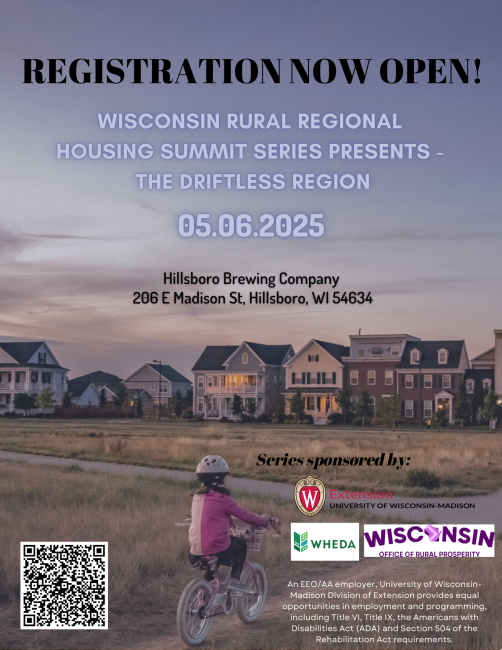

2025 Wisconsin Rural Regional Housing Summit Series
by Hannah McKeever
“The UW-Madison Division of Extension – Vernon and La Crosse Counties hosted the second stop of the Wisconsin Rural Regional Housing Summit Series, a groundbreaking initiative designed to address the pressing housing challenges faced by rural communities across Wisconsin. This series of four regional workshops aims to build local capacity, facilitate regional partnerships, and strengthen connections to local, state and federal stakeholders whose participation will be instrumental in shaping the future of housing in rural Wisconsin.”
Community Development Publications
The Learning Store produces and distributes educational materials based on university research, extending knowledge to the statewide community.
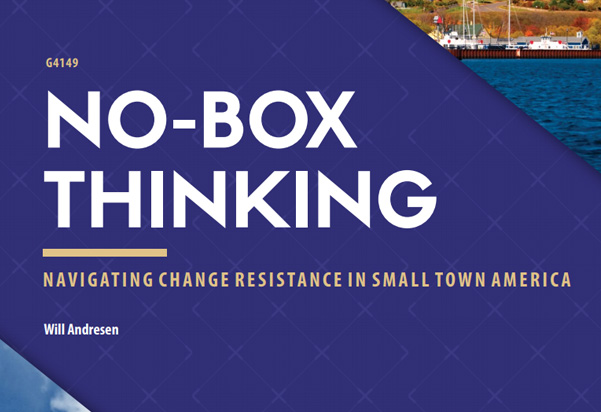
Featured Publication
No-Box Thinking offers a framework for understanding the automatic and powerful resistance to change those engaged in community development often face. This book details how to convert the powerful sources of community change resistance—identity, emotion, and social connections—into powerful forces for transformational change (105 pages; 2018).
View Related Topics on the Learning Store
Latest News in Community Development
- The University of Wisconsin Center for Cooperatives (UWCC) was awarded $127,000 by the Wisconsin Economic Development Corporation to boost cooperative development throughout the state of Wisconsin. The funding will allow UWCC to expand technical assistance for start-ups, conversions, and existing co-ops, and address one of Wisconsin’s pressing concerns: retiring business owners without succession plans. “Like […]
- Professor Melissa Kono, a municipal clerk specialist in the Local Government Education program, was named the 2026 recipient of the Wisconsin Idea Teaching Award. Kono was honored for her work to exemplify the guiding philosophy of UW–Madison’s outreach efforts to extend the borders of the university. Kono meets her students where they are — literally. […]
- In an era of increased political polarization, innovative approaches to bringing diverse voices together may offer ways for communities to rebuild trust and increase civic dialogue. Polarization has far-reaching consequences. As Americans increasingly distrust those with different political views, polarization can erode trust, narrow social connections, and discourage everyday civic conversation. Public meetings can become […]
- Like many rural and northern Wisconsin communities, Merrill’s population decline is shaped by an aging population and fewer young people moving to or staying in the area. “If you don’t address those and turn those around, what happens is your city, no matter what you do, will struggle to remain vibrant,” said Scott Steele, former […]
- As the New Glarus Village Administrator, Kelsey Jenson is thinking about AI and how it affects her work. “AI is here and continuing to grow, whether we like that or not. I think it’s imperative for local government officials to know how AI is already being used in our work,” she said. For public entities […]
- Losing critical institutions and services makes it more difficult to have a thriving community and live in rural places. For communities in Wisconsin, there are planning tools and resources that are focused on increasing livability. The Rural Livability Project “Livability” is what makes somewhere a good place to live and work. But what livability looks […]
Latest Updates in Community Development
- The University of Wisconsin Center for Cooperatives (UWCC) was awarded $127,000 by the Wisconsin Economic Development Corporation to boost cooperative development throughout the state of Wisconsin. The funding will allow UWCC to expand technical assistance for start-ups, conversions, and existing co-ops, and address one of Wisconsin’s pressing concerns: retiring business owners without succession plans. “Like […]
- Professor Melissa Kono, a municipal clerk specialist in the Local Government Education program, was named the 2026 recipient of the Wisconsin Idea Teaching Award. Kono was honored for her work to exemplify the guiding philosophy of UW–Madison’s outreach efforts to extend the borders of the university. Kono meets her students where they are — literally. […]
- In an era of increased political polarization, innovative approaches to bringing diverse voices together may offer ways for communities to rebuild trust and increase civic dialogue. Polarization has far-reaching consequences. As Americans increasingly distrust those with different political views, polarization can erode trust, narrow social connections, and discourage everyday civic conversation. Public meetings can become […]
- Like many rural and northern Wisconsin communities, Merrill’s population decline is shaped by an aging population and fewer young people moving to or staying in the area. “If you don’t address those and turn those around, what happens is your city, no matter what you do, will struggle to remain vibrant,” said Scott Steele, former […]
- As the New Glarus Village Administrator, Kelsey Jenson is thinking about AI and how it affects her work. “AI is here and continuing to grow, whether we like that or not. I think it’s imperative for local government officials to know how AI is already being used in our work,” she said. For public entities […]
Related Links of Interest
Staff
If you have any questions regarding Community Development in Vernon County, please contact:
Community Development Educator, Hannah McKeever

Extension Vernon County
UW-Madison Division of Extension
318 Fairlane Drive
Viroqua, WI 54665
Phone: 608-637-5281
Email: hannah.mckeever@wisc.edu